Pricing your used EV in 2026 is one of the biggest factors that determines whether you get serious buyer messages or weeks of low-ball offers.
Most private sellers make one of two mistakes:
- They list too high based on old headlines or dealer asking prices
- They list too low and leave money on the table
The best pricing strategy is not guessing. It is building a realistic private-party price range based on local comps, your EV's condition, and EV-specific details like battery/range fit, charging history, and title status.
This guide shows you how to price your used EV in 2026 so you can attract qualified buyers faster without underpricing your car.
2026 Pricing Reality: Why Old EV Pricing Advice Can Be Wrong
Many older EV pricing articles still assume buyers will factor in a federal used EV tax credit when comparing sub-$25,000 vehicles. IRS guidance now states the Previously-Owned Clean Vehicle Credit is not available for vehicles acquired after Sept. 30, 2025 (with limited transition rules for qualifying earlier acquisitions).
What that means for sellers in 2026:
- Some buyers may be more price-sensitive than they were in 2024-2025
- Older "price it high because buyer gets a tax credit" logic may not hold
- Accurate local comps matter more than national headlines
If you want strong buyer response, price for today's market, not last year's incentives.
The Goal: Set 3 Prices (Not 1)
Before you publish your listing, define these three numbers:
- Asking Price: the public number on your listing
- Target Price: what you realistically expect to sell for
- Walk-Away Floor: the lowest price you will accept
This helps you avoid emotional decisions when buyers negotiate.
Step 1: Build the Right Comp Set (Most Sellers Get This Wrong)
Do not compare your EV to every vehicle with the same badge. Build a comp set that matches the parts buyers actually care about.
Match as closely as possible on:
- Year
- Make and model
- Trim
- Battery / drivetrain configuration
- Mileage range
- Title status (clean vs salvage)
- Condition (interior, exterior, wheels, tires)
- Major options/features
Example: A Tesla Model 3 Long Range with moderate mileage should not be priced against a base RWD trim or a salvage-title listing just because the model name matches.
Step 2: Start with Private-Party Value Benchmarks (Then Verify Locally)
Use valuation tools as a starting point, not the final answer. Good benchmark tools can help you estimate a private-party value and compare it with trade-in and dealer pricing ranges.
Useful references include:
- Kelley Blue Book (trade-in vs private-party values)
- Edmunds appraisal tools and private-party value references
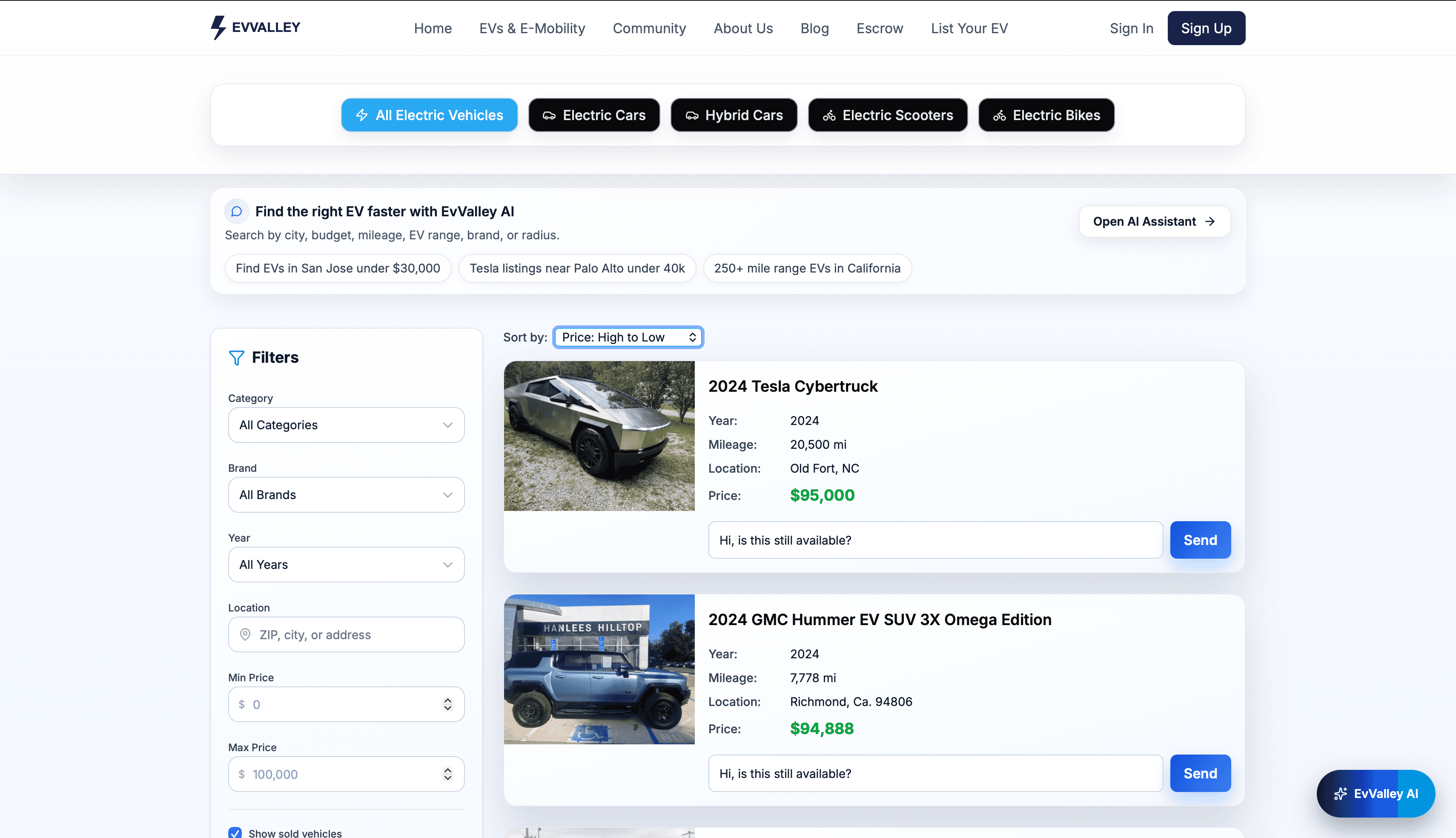
- Local marketplace listings (including EvValley)
Important: dealer asking prices are usually not the same as private-party pricing. Use them for context, but do not price your vehicle as if you are a dealer offering financing, warranty options, and reconditioning.
Step 3: Compare Local Listings Buyers Will Actually See
After you estimate a private-party range, check real listings in your region. Buyers compare your EV against what they can find nearby, not a national average.
Review listings within a realistic radius and compare:
- Asking price
- Mileage
- Trim and battery/drivetrain
- Condition and photo quality
- Title status
- How complete and trustworthy the listing looks
If your EV is priced above better-looking local listings, you will get fewer messages. If your listing is clearer and better documented, you may justify a stronger asking price.
Browse EV listings on EvValley to compare your local market
Step 4: Adjust for EV-Specific Value Factors (This Is Where Seller Pricing Gets Better)
EV pricing is not only about year and mileage. Buyers also care about how usable and trustworthy the EV feels today.
1) Battery / Range Confidence
Buyers want confidence that the EV still fits their daily needs. If you can provide clear, realistic range information and honest ownership notes, your listing becomes easier to trust.
Helpful details to include:
- Current estimated range (realistic, not exaggerated)
- Your typical commute/use pattern
- Charging habits (home charging vs frequent DC fast charging, if relevant)
- Any battery or major component service history
2) Mileage (But in Context)
Mileage matters, but it should be judged together with condition, maintenance history, and price. A well-maintained EV with higher mileage can still be a strong buy if priced correctly.
Do not use a single "dollars per mile" formula for every EV. Compare similar local listings first.
3) Title Status and Accident History
Title status has a major pricing impact. If your car has a salvage/rebuilt title, price expectations should be adjusted significantly and disclosed clearly.
Kelley Blue Book notes that salvaged/reconstructed titles often carry a substantial permanent value reduction and should be evaluated case by case.
4) Tires, Wheels, and Cosmetic Condition
Buyers often price your car down immediately if they expect near-term tire replacement, wheel repairs, or paint correction. Addressing or clearly documenting these items can improve buyer confidence.
5) Recalls and Service Readiness
Before listing, check for open recalls by VIN on the NHTSA recall site. A buyer who discovers an open recall before you mention it may trust your listing less.
Step 5: Choose a Pricing Strategy Based on Your Goal
There is no single perfect price. The right price depends on your goal.
If you want to sell faster
- Price near the stronger-value end of your local comp range
- Use excellent photos and a complete description
- Respond quickly to messages
If you want to maximize sale price
- List slightly above your target price
- Expect negotiation
- Make your listing documentation stronger than competing listings
Practical rule: Do not price high and publish a weak listing. If your ask is above average, your photos, description, and vehicle transparency must be better than average too.
Step 6: Set an Asking Price That Still Leaves Room to Negotiate
Buyers expect some negotiation in private-party sales. That does not mean you should add a random amount.
Use this framework:
- Asking Price: slightly above your target if your listing quality is strong
- Target Price: your realistic expected sale number
- Walk-Away Floor: your minimum acceptable number before listing goes live
This keeps your negotiations disciplined and prevents panic price cuts after one low offer.
Step 7: Publish a Listing That Supports Your Price
Pricing and listing quality work together. A fair price with poor photos can still underperform.
To support your asking price, include:
- Clear title with year, make, model, and trim
- Accurate mileage
- Battery/range and charging notes
- Condition details (do not hide issues)
- Title status
- Strong photos in daylight
On EvValley, your listing plan also affects how much media you can include:
- Basic: up to 6 photos
- Standard: up to 15 photos + 1 short video (<60s)
- Premium: up to 25 photos + 1 short video (<60s)
More complete media can support a stronger asking price because buyers trust what they can clearly see.
See listing plans and list your EV on EvValley
What to Do If You Get Views but No Messages
If your listing gets impressions but few messages, the issue is usually one of these:
- Price too high vs local comps
- Weak photo quality
- Missing key details (trim, battery/range, title status)
- Low trust due to vague description
Before cutting price aggressively, fix the listing quality first. Then compare your asking price against the strongest nearby comps again.
If your listing is complete and still underperforming after a reasonable period, a measured price adjustment is usually better than a large drop.
Common Used EV Pricing Mistakes (Avoid These)
- Using dealer asking prices as your private-party price target
- Ignoring trim and battery differences in comps
- Pricing from national headlines instead of local listings
- Hiding condition issues (buyers notice later and walk away)
- Changing price without improving the listing
- Not deciding your minimum acceptable price before listing
A Simple Used EV Pricing Checklist (Before You Publish)
- Built a comp set with similar year/trim/battery/mileage
- Compared local listings buyers will actually see
- Checked KBB/Edmunds private-party/trade-in references
- Reviewed title status and accident history impact
- Checked open recalls by VIN (NHTSA)
- Set asking, target, and floor prices
- Prepared clear photos and an honest description
List Your EV on EvValley
If you want more serious buyer messages, pricing is only half the job. The other half is a trustworthy listing.
- Choose the right plan for your photos/video needs
- Write a clean, complete listing
- Price against real local EV comps
- Respond quickly to qualified buyers
Frequently Asked Questions
Should I price my used EV above what I actually want to get?
Usually yes, within reason. Set an asking price that leaves room for negotiation, but do not overprice far above local comps or you may reduce buyer messages significantly.
Should I use trade-in value or private-party value to price my EV?
For a private sale, private-party value is the better benchmark. Trade-in value is useful as a floor comparison because it reflects a faster, lower-effort sale path.
How much does a salvage title affect EV value?
It can reduce value substantially and permanently. The exact impact varies by vehicle and market. Price salvage or rebuilt-title EVs against similar-title comps, not clean-title listings.
Why is my EV listing getting views but no messages?
The most common reasons are price vs local comps, weak photos, missing trim/battery details, or low buyer trust from an incomplete description.
Should I mention charging habits and battery details in my listing?
Yes. Clear battery/range and charging information helps buyers trust your listing and can improve message quality.
Sources (Verify Before Publish)
- IRS: Used Clean Vehicle Credit (official)
- IRS: Clean Vehicle Tax Credits (official)
- Kelley Blue Book: My Car's Value
- Kelley Blue Book: Values FAQ (condition, private party, title impact)
- Edmunds Appraisal Tool
- Edmunds: Used car fair price guidance
- NHTSA Recalls Lookup (official)
- FTC Consumer Advice: Used Cars
This article is general information and not legal, tax, or appraisal advice. Pricing varies by location, condition, trim, battery, title status, and market timing.